
Clear PVC vs Mesh Fabric: Which Material Is Suitable for Your Application?
Sep. 17, 2026
Key Takeaways
-
Clear PVC is a solid, transparent material suited to applications where visibility, water resistance, wind protection, or enclosure is important.
-
Mesh fabric has an open structure that allows air and light to pass through, making it suitable for ventilation, insect protection, breathable products, and lightweight applications.
-
The right material depends more on your application requirements than on the material itself.
-
For applications requiring airflow, lightweight construction, or controlled mesh openings, polyester mesh fabric can be a practical choice.
-
When sourcing mesh for bulk production, consider material, mesh opening, GSM, width, color, finish, and application before requesting a quotation.
If you are comparing clear PVC and mesh fabric for a new product, the first question is not which material is better. It is what the material needs to do. Clear PVC provides a solid and transparent barrier, while mesh fabric provides an open structure for airflow, light transmission, and ventilation. Understanding this difference can help you select the right material before placing a bulk order.
Clear PVC vs Mesh Fabric: What Is the Main Difference?
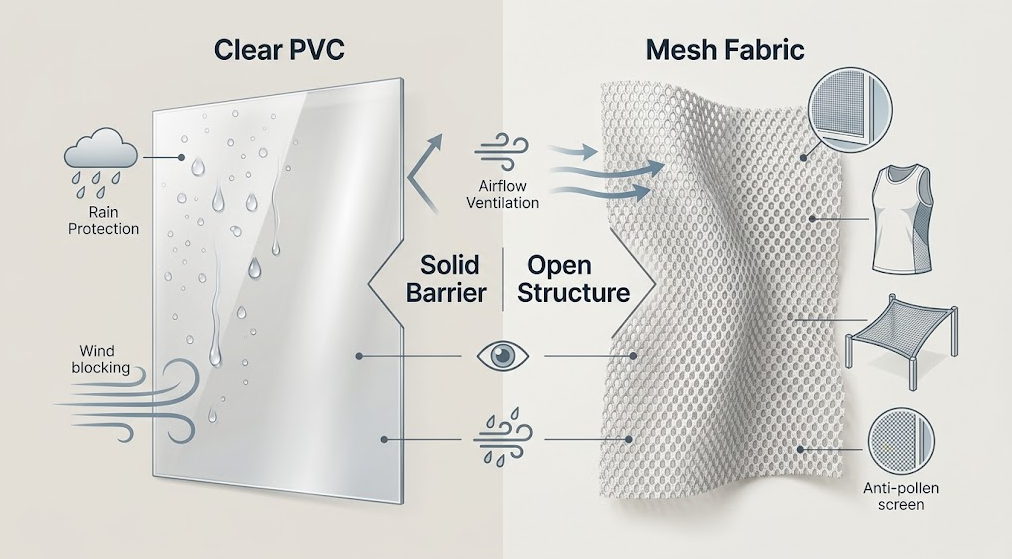
The fundamental difference is their structure.
Clear PVC is a solid transparent material. Because it does not have an open-hole structure, it can provide a barrier against rain, wind, dust, and other external elements while maintaining visibility.
Mesh fabric is an open textile structure made with knitted or woven yarns. The openings allow air and light to pass through, with the performance depending on the mesh size, density, material, and construction.
For a simple comparison:
| Property | Clear PVC | Mesh Fabric |
|---|---|---|
| Structure | Solid, transparent | Open-hole textile |
| Transparency | High | Depends on mesh structure |
| Airflow | Low when used as a solid sheet | High |
| Light transmission | High | Depends on mesh density |
| Ventilation | Limited | Excellent |
| Wind/rain barrier | Strong | Depends on construction and coating |
| Weight | Depends on thickness | Generally lightweight |
| Mesh opening customization | Not applicable | Available |
| Typical applications | Enclosures, covers, protective barriers | Sportswear, screens, bags, outdoor and technical products |
The key decision is therefore straightforward:
Choose a solid transparent material when barrier protection and visibility are the priority. Choose mesh when airflow, ventilation, lightweight construction, or controlled openings are more important.
When Should You Choose Clear PVC?
Clear PVC can make sense when your application requires a solid, transparent barrier rather than an open textile.
Typical requirements may include:
-
Visibility through the material
-
Protection from rain or wind
-
A closed surface
-
Separation or enclosure
-
Easy visual inspection of the area behind the material
For example, applications that require an enclosed space while maintaining visibility may benefit from a transparent solid material.
However, clear PVC is not a direct substitute for every type of mesh. If the product needs continuous airflow or ventilation, a solid material can restrict air movement.
Clear PVC May Be More Suitable When:
-
The material needs to remain transparent.
-
Water or wind protection is important.
-
You need a closed barrier.
-
Ventilation is not the primary requirement.
-
The application requires an enclosed surface.
If these are your main requirements, a transparent PVC material may be worth considering.
When Should You Choose Mesh Fabric?
Mesh fabric becomes more suitable when the product needs airflow, ventilation, lightweight construction, or a controlled opening structure.
Qicai Knitting specializes in knitted fabrics, including 100% polyester mesh fabric for OEM and bulk applications. The open structure can provide airflow while maintaining a lightweight textile construction.
Common mesh applications include:
-
Sportswear and functional apparel
-
Outdoor gear and tents
-
Window screens
-
Mosquito and anti-pollen screens
-
Bags and luggage
-
Automotive interiors
-
Industrial and technical applications
-
Laundry bags and household products
For example, Qicai's mesh fabric product range includes polyester mesh designed for applications such as sportswear, outdoor gear, automotive interiors, bags, window screens, and other customized products.
Clear PVC vs Mesh Fabric for Airflow and Ventilation
This is one of the biggest differences between the two materials.
A solid clear PVC material forms a continuous surface, so it does not provide the same natural airflow as an open mesh.
Mesh fabric, by contrast, is designed around openings. The size and density of those openings directly affect how much air and light can pass through.
For example, Qicai's window screen content explains that mesh density influences airflow, visibility, and the ability to block insects and smaller particles. Higher density generally means smaller openings, which can provide more coverage but may reduce airflow compared with a more open mesh.
This makes mesh particularly useful when you need to balance:
insect protection + airflow + visibility
rather than completely enclosing an area.
Clear PVC vs Mesh Fabric for Visibility
Both materials can allow visibility, but they achieve it differently.
Clear PVC
Clear PVC provides visibility through a continuous transparent surface. It is therefore suitable when maintaining a relatively unobstructed view is a major requirement.
Mesh Fabric
Mesh provides visibility through its openings.
The final visibility depends on:
-
Mesh opening size
-
Mesh density
-
Yarn thickness
-
Fabric color
-
Viewing distance
-
Application
For window screening, for example, selecting the right mesh density involves balancing insect protection with airflow and visibility.
Qicai currently offers polyester window screen mesh and anti-pollen mesh solutions, including high-density options designed to help prevent pollen and insects while maintaining indoor air circulation.
Clear PVC vs Mesh Fabric for Outdoor Applications
Outdoor applications require more than simply choosing a material that looks suitable.
You should consider:
-
Exposure to rain
-
Airflow requirements
-
Sunlight exposure
-
Required durability
-
Weight
-
Cleaning requirements
-
Required protection level
-
Whether the material needs to be open or enclosed
A solid transparent material may be appropriate when the priority is creating a barrier against weather.
Mesh may be more suitable when ventilation is important.
For example, Qicai's polyester mesh products are used in outdoor-related applications such as tents, backpacks, mosquito nets, and other outdoor gear.
For applications where the product needs to breathe rather than completely seal, mesh is generally the more relevant material category.
Clear PVC vs Mesh Fabric for Window Screens
Window screening is a good example of why application requirements matter.
A window screen normally needs to perform several functions at the same time:
-
Keep insects out
-
Allow air to circulate
-
Allow natural light to enter
-
Maintain reasonable visibility
-
Provide sufficient durability for repeated use
These requirements naturally favor an open mesh structure.
Qicai's window screen mesh content focuses on mesh density such as 18×16, 20×20, and 40×40, showing how different opening structures can be selected according to the required balance between protection, airflow, and visibility.
For applications such as mosquito screening and anti-pollen window screens, Qicai also supplies polyester mesh products designed around these requirements.
Clear PVC vs Mesh Fabric for Sportswear and Apparel
For apparel, the decision is usually much simpler.
A breathable open textile structure is generally required for products such as:
-
Sports jerseys
-
Training apparel
-
Breathable panels
-
Linings
-
Safety vests
-
Performance clothing
This is where polyester mesh has a clear functional role.
Qicai's polyester mesh products are designed for applications where airflow, lightweight construction, durability, and customization are important. Available parameters can include mesh size, GSM, color, and functional treatments depending on the product and application.
Clear PVC, by comparison, is generally not the natural choice when the final product needs to be soft, breathable, and comfortable to wear.
How to Choose the Right Mesh Fabric for Your Application
If you decide that mesh is more appropriate for your project, choosing the right mesh is the next step.
Do not select a mesh fabric based only on the word "polyester mesh." Different constructions can provide very different performance.
1. Define the Application
Start with the final product.
For example:
-
Sportswear → breathable and lightweight mesh
-
Window screens → controlled opening size and insect protection
-
Outdoor gear → durability and appropriate weather performance
-
Bags → strength, flexibility, and appearance
-
Automotive interiors → dimensional stability and durability
-
Industrial applications → specific opening, strength, or functional requirements
Qicai's existing mesh range covers several of these application directions, including sportswear, outdoor gear, automotive interiors, bags, window screens, and industrial uses.
2. Choose the Material
Polyester is one of the main materials used in Qicai's mesh fabric range.
Polyester mesh can provide a practical combination of:
-
Durability
-
Lightweight construction
-
Shape stability
-
Breathability
-
Customization potential
Qicai's existing technical content also compares polyester and nylon mesh and explains that the appropriate material depends on the intended application and required performance.
3. Consider Mesh Opening and Density
Mesh opening is particularly important when the fabric is used for screening.
A larger opening can generally provide more airflow and visibility, while a smaller opening can provide greater coverage against insects or smaller particles.
For window screen applications, this is why specifications such as 18×16, 20×20, or 40×40 should be selected according to the intended use rather than simply choosing the highest density.
4. Check GSM and Thickness
GSM affects the weight and overall construction of the fabric.
Lightweight mesh may be suitable for apparel and breathable products, while heavier constructions may be more appropriate for products requiring additional strength or structure.
Before placing a bulk order, confirm:
- GSM
- Thickness
- Usable width
- Mesh opening
- Color
- Finish
5. Confirm Customization Requirements
For OEM projects, the standard product specification may not be enough.
Depending on the application, you may need to confirm:
- Mesh structure
- Hole size
- GSM
- Width
- Color
- Printing
- Functional treatment
- Roll length
- Packaging
- MOQ
Qicai's OEM mesh offering allows buyers to discuss these parameters according to the final application.
Clear PVC or Mesh Fabric: Which One Should You Choose?
There is no universal winner because the two materials solve different problems.
Use the following quick guide:
| If your priority is... | Consider |
|---|---|
| Maximum transparency | Clear PVC |
| A solid barrier | Clear PVC |
| Rain and wind protection | Clear PVC |
| Continuous airflow | Mesh Fabric |
| Ventilation | Mesh Fabric |
| Insect screening | Mesh Fabric |
| Lightweight construction | Mesh Fabric |
| Breathable apparel | Mesh Fabric |
| Custom mesh openings | Mesh Fabric |
| Window screening | Mesh Fabric |
| Sportswear | Polyester Mesh |
| Outdoor breathable products | Polyester Mesh |
The most important question is:
Does your product need to block the environment or allow air to pass through?
If you need a transparent barrier, clear PVC may be worth considering. If your product needs airflow, ventilation, insect protection, or an open textile structure, mesh fabric is usually the more relevant direction.
Why Polyester Mesh May Be a Practical Choice for Bulk Production
For buyers sourcing mesh fabric in commercial quantities, polyester mesh offers several practical advantages.
Qicai Knitting supplies 100% polyester mesh fabric for OEM and bulk production, with customization options covering parameters such as mesh size, GSM, color, and functional treatments.
The company also supplies different mesh solutions for applications including:
- Sportswear
- Outdoor gear
- Automotive interiors
- Bags and luggage
- Window screens
- Industrial and technical products
This application-based approach is important because the best mesh specification depends on the product you are manufacturing—not simply on the fabric name.
What Information Should You Provide When Requesting a Mesh Fabric Quote?
If you are contacting a mesh fabric manufacturer, providing the basic specifications upfront can make the quotation process more efficient.
Ideally, include:
- End application
- Material preference
- Mesh opening or mesh density
- GSM or target weight
- Fabric width
- Color
- Required finish or treatment
- Estimated order quantity
- Roll or packaging requirements
- Sample requirements
If you do not know the exact mesh specification, provide the final product, application, target performance, and a reference sample or photo.
A manufacturer can then help determine a suitable mesh structure before bulk production.
Frequently Asked Questions
Is clear PVC the same as mesh fabric?
No. Clear PVC is a solid transparent material, while mesh fabric has an open structure that allows air and light to pass through.
Is mesh fabric better than clear PVC?
Neither material is universally better. Clear PVC is more suitable for solid transparent barriers, while mesh fabric is more suitable when airflow, ventilation, or an open structure is required.
What type of mesh fabric does Qicai Knitting supply?
Qicai Knitting specializes in knitted fabrics, including 100% polyester mesh for OEM and bulk applications, with options for different mesh structures, GSM, colors, widths, and functional requirements.
What mesh fabric is suitable for window screens?
The appropriate mesh depends on the required balance between insect protection, airflow, visibility, and particle blocking. Qicai supplies polyester window screen and anti-pollen mesh options for these applications.
Can Qicai customize mesh fabric?
Yes. Qicai's OEM mesh offering supports customization of parameters such as mesh size, weight, color, and functional treatments according to the application.
Need Mesh Fabric for Your Project?
If your application requires airflow, ventilation, insect screening, lightweight construction, or a customized open textile structure, Qicai Knitting can help you select a suitable polyester mesh specification.
Share your application, target mesh size, GSM, width, color, and estimated quantity with our team. If you are not sure about the exact specification, send us your product requirements or reference sample so we can discuss the appropriate mesh solution.