
Why Dimensional Stability Matters in Magnetic Mosquito Net Manufacturing
Aug. 06, 2026
Dimensional stability matters because a magnetic mosquito net must keep its cut size and shape well enough for the two closure edges to meet repeatedly. If the mesh grows, shrinks, twists or sags during processing or use, the magnets may no longer align, gaps can appear, and an otherwise acceptable fabric can become difficult to sew into a reliable door screen. Manufacturers should therefore evaluate stability together with mesh geometry, weight, stretch behavior, sewing response and the finished-screen design—not as an isolated number.
Key Takeaways
- Dimensional stability is the ability of mesh to retain its intended length, width and shape after handling, sewing and relevant care or conditioning.
- Poor stability can cause center-line misalignment, edge gaps, uneven hems, sagging and inconsistent finished dimensions.
- GSM alone cannot predict stability. Yarn, knit construction, finishing, mesh geometry and production tension all matter.
- Test the fabric in both directions and then test a sewn prototype under the conditions the finished product will actually face.
- ISO 3759, ISO 5077 and ISO 6330 provide a recognized framework for measuring dimensional change after specified treatments, but the buyer must set project-specific acceptance limits.
What Does Dimensional Stability Mean for Magnetic Mosquito Net Fabric?
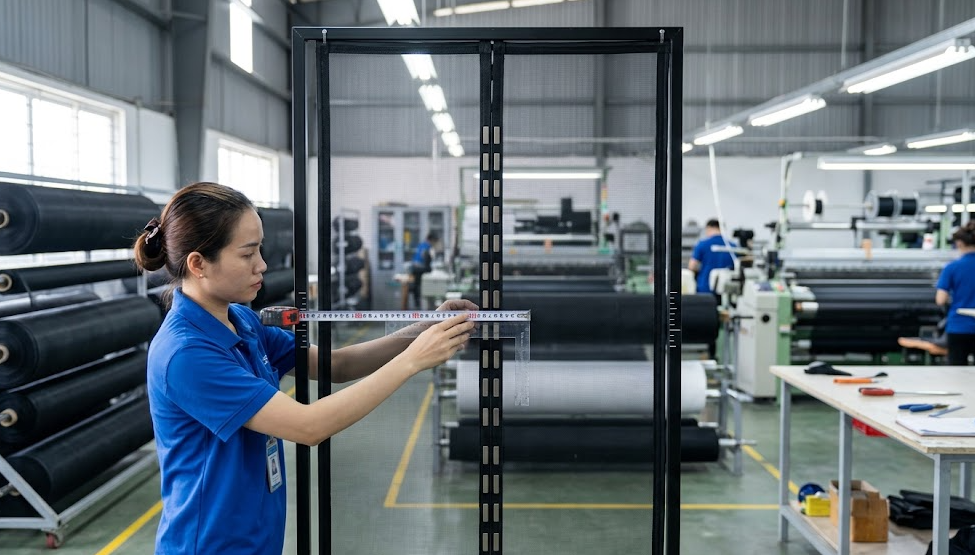
For a magnetic door screen, dimensional stability means more than resistance to washing shrinkage. It includes the mesh’s ability to remain square, maintain consistent length and width, and avoid permanent distortion after unwinding, cutting, sewing, hanging and repeated opening.
A magnetic screen is a fabric assembly. The mesh is joined to edge binding, hook-and-loop tape, weights and magnets. Even when the magnets are strong enough, the screen may close poorly if the textile panels no longer hang symmetrically.
Buyers comparing materials can start with Qicaiknitting’s mosquito mesh fabric page, then confirm the final door construction before approving a production fabric.
How Unstable Mesh Creates Closure Problems
The center opening of a magnetic screen works only when opposing magnets return to approximately the same positions. Several fabric-related changes can interrupt that movement.
|
Observed problem |
Possible fabric or assembly cause |
What to check |
|
Center seam stays open |
One panel has lengthened, twisted or been cut off-grain |
Compare both panels, diagonals and magnet spacing |
|
Bottom edge drags |
Length growth, excessive stretch or insufficient top support |
Measure before and after hanging |
|
Screen pulls away from the frame |
Width loss, uneven side tension or incompatible binding |
Check finished width and perimeter attachment |
|
Wavy sewn edge |
Differential feeding between mesh and binding |
Review sewing tension, feed and operator method |
|
Openings look distorted |
Knit deformation during spreading or cutting |
Inspect mesh geometry in both directions |
This is a diagnostic guide, not proof that every closure issue comes from the mesh. Door dimensions, magnet placement, binding and installation can produce similar symptoms.
The Four Stages Where Dimensions Can Change
1. Roll relaxation
Residual tension from knitting, finishing and winding can relax after a roll is opened. Measure and cut samples after an agreed relaxation period.
2. Cutting and sewing
Open mesh can distort on the cutting table. During sewing, uneven feeding or a stiff binding can stretch one edge more than another. The result may appear only after hanging.
3. Hanging and repeated opening
A screen carries its own weight from the header and receives repeated loads in use. A sample that looks square on a table may sag when installed, so prototype testing should include hanging and repeated closure.
4. Cleaning or environmental exposure
If the product will be washed, soaked or exposed to humidity, the approval method should reproduce those conditions as closely as practical.
A Practical Sample-Test Workflow
The following workflow gives buyers and converters a repeatable starting point.
Condition → Mark → Measure → Treat → Recondition → Remeasure → Sew → Hang → Review closure
- Agree on the conditioning, care or exposure procedure.
- Take specimens across the width and mark distances in both directions.
- Record original distances, width, GSM and mesh geometry.
- Apply the same treatment to every sample, then recondition and remeasure.
- Calculate dimensional change for each direction.
- Sew a representative prototype with the intended binding and magnet spacing.
- Hang it and inspect center alignment, edge contact and bottom clearance.
- Keep the approved sample and record as the production reference.
For broader material-selection questions, Qicaiknitting’s mosquito net buying guide explains common materials and purchasing specifications. The present workflow goes one step further by testing whether the chosen mesh works in a magnetic closure assembly.
Which Technical Standards Are Relevant?
Three ISO documents form a useful measurement framework:
|
Reference |
What it covers |
How a manufacturer can use it |
|
ISO 3759:2011 |
Preparing, marking and measuring textile specimens for dimensional-change testing |
Establish consistent reference marks and measurements |
|
ISO 5077:2007 |
Determining dimensional change after specified washing and drying procedures |
Calculate percentage change after the agreed treatment |
|
ISO 6330:2021 |
Defined domestic washing and drying procedures for textile testing |
Select a repeatable treatment when home laundering is relevant |
These standards provide controlled methods, not a universal pass/fail limit for magnetic mosquito nets. Acceptance criteria must reflect the product design and buyer requirements.
How to Write a Better Fabric Requirement
“Stable polyester mesh” is too vague for an RFQ. A useful requirement should state:
- finished product type and door dimensions;
- mesh material and required construction;
- target width, GSM and mesh appearance;
- whether stretch is allowed and in which direction;
- intended cleaning or exposure conditions;
- measurement method and maximum acceptable change in each direction;
- binding, magnet and sewing method used in the prototype;
- sample size and approval procedure;
- packaging and roll-relaxation requirements.
If any value has not been validated, mark it instead of copying a number from an unrelated mosquito-net specification.
Work With Qicaiknitting on a Production-Ready Sample
Qicaiknitting supplies warp-knitted polyester and nylon mesh for mosquito nets, window screens and related applications. For a magnetic screen project, share the door size, panel structure, target GSM, stretch preference, binding method and trial quantity.
Our team can discuss a sample for your cutting, sewing and closure tests. You can also explore our fabric for tent and insect-screen applications or Qicaiknitting’s warp-knitted mesh manufacturing background.
Ready to evaluate mesh for a magnetic door screen? Contact Qicaiknitting with your drawing, target dimensions and test requirements. We will help you identify what must be confirmed before bulk production.
FAQ
Is polyester mesh always dimensionally stable?
No. Polyester is often selected where shape retention is important, but actual performance still depends on yarn, knit structure, finishing, heat setting, fabric tension and the test conditions. Approve the specific construction and production sample rather than relying on the fiber name alone.
Should dimensional change be tested in both directions?
Yes. Warp-knitted mesh can respond differently along its machine and cross directions. Record both results and keep the specimen orientation consistent through cutting and assembly.
What should buyers send when requesting a sample?
Send the application, door dimensions, panel drawing, preferred material, GSM or reference sample, stretch requirement, width, order quantity and test method. Add the binding and magnet layout when closure alignment is the main concern.