
How to Choose the Right Mesh Opening Size?
Sep. 28, 2026
The right mesh opening size depends on what the fabric needs to let through and what it needs to keep out. For applications such as window screens, sportswear, filtration, outdoor products, and technical textiles, buyers should consider airflow, visibility, protection, particle or insect size, fabric strength, and the final application before selecting a mesh opening.
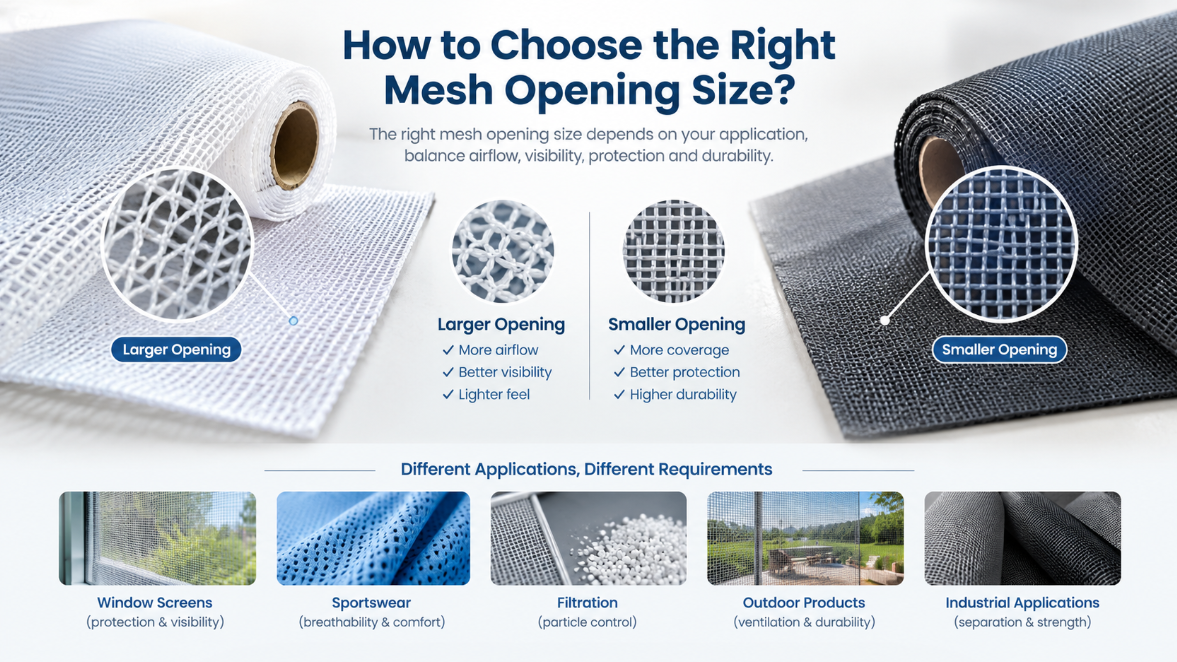
A smaller opening generally provides greater coverage and protection, while a larger opening allows more airflow and visibility. However, mesh opening should not be evaluated alone. Material, GSM, yarn size, mesh density, and fabric construction can all affect the final performance.
Key Takeaways
- Smaller mesh openings generally provide greater coverage and can improve protection against smaller particles or insects.
- Larger mesh openings generally allow more airflow and visibility.
- Mesh opening should be selected according to the application's actual requirements, not simply by choosing the smallest or largest available size.
- Mesh opening, mesh density, GSM, yarn size, and fabric construction work together to determine fabric performance.
- Window screens, sportswear, outdoor products, and industrial applications may require very different mesh specifications.
- For OEM and bulk orders, buyers should provide the application, target opening, material, GSM, width, color, and required performance to the manufacturer.
What Is Mesh Opening Size?
Mesh opening size refers to the open space between the yarns in a mesh fabric.
It is one of the most important specifications because it determines how much of the fabric's surface remains open for air, light, water, particles, or other materials to pass through.
For example:
- A larger mesh opening creates a more open structure and generally allows greater airflow and visibility.
- A smaller mesh opening creates a denser structure and generally provides greater coverage and screening capability.
However, two fabrics with similar-looking openings can still perform differently if they use different yarn sizes, materials, GSM, or construction methods.
This is why mesh opening should always be considered together with the complete fabric specification.
Mesh Opening Size vs Mesh Density
Mesh opening and mesh density are related, but they are not exactly the same specification.
Mesh opening describes the size of the open space.
Mesh density describes how closely the yarns or openings are arranged across a specific area.
A fabric with smaller openings will generally have a denser structure, while a fabric with larger openings will generally have more open space. But the final relationship depends on yarn diameter and fabric construction.
For window screen applications, for example, a specification such as 18 × 16 mesh describes the number of openings in a defined length in the two directions. The actual opening size also depends on the diameter of the yarn.
Therefore, buyers should avoid selecting mesh solely by a number such as 18 × 16 or 20 × 20. The actual opening dimension and application requirements should also be confirmed.
How Does Mesh Opening Affect Airflow?
Mesh opening has a direct influence on the amount of open area available for air to pass through.
In general:
Larger opening → more open area → greater potential airflow
Smaller opening → less open area → greater coverage
This does not mean that a larger opening is always better. In a window screen, for example, increasing airflow may come with reduced screening against smaller insects.
For breathable garment mesh, a more open structure may be useful when ventilation is a priority. For screening applications, however, buyers may need to balance airflow with protection.
The right choice is therefore the best balance for the application rather than the maximum possible opening.
How Does Mesh Opening Affect Visibility?
Mesh opening can also affect visibility.
A more open mesh structure generally allows more light and visual access through the fabric. A denser structure can provide greater visual screening but may reduce transparency.
This makes mesh opening particularly important for:
- Window screens
- Outdoor enclosures
- Protective screens
- Architectural textiles
- Some sportswear and apparel applications
If visibility is important, buyers should compare the actual open area and fabric appearance rather than relying only on the nominal mesh count.
How to Choose Mesh Opening for Window Screens
Window screens are one of the clearest examples of why mesh opening matters.
The screen needs to provide a balance between:
- Insect protection
- Airflow
- Visibility
- Durability
- Cleaning and maintenance
- Environmental exposure
A relatively open mesh may provide better airflow and visibility, while a tighter mesh can improve protection against smaller insects and particles.
For standard insect screening, buyers should consider the target insect size and the required balance between ventilation and protection.
For specialized applications such as no-see-um or fine insect screening, a smaller opening may be required.
However, smaller openings can also reduce airflow and increase the amount of material in the structure. The final specification should therefore be selected based on the actual use rather than assuming that the smallest opening is automatically the best choice.
For a more detailed look at screen specifications, see our guide on how to choose mesh density for window screen rolls.
How to Choose Mesh Opening for Sportswear and Garments
For apparel, the main goal is usually different from screening.
Mesh fabrics used in sportswear and garments may need to provide:
- Breathability
- Moisture ventilation
- Lightweight construction
- Flexibility
- Comfort
- Appropriate coverage
- Desired appearance
A larger opening can increase ventilation, making it useful for areas where airflow is a priority.
A smaller opening can provide more coverage and a more compact textile appearance.
The appropriate opening therefore depends on where the mesh will be used. For example, a highly ventilated sportswear panel may require a different mesh structure from a garment lining or decorative mesh component.
Material and GSM should also be considered because they affect hand feel, durability, and overall garment performance.
How to Choose Mesh Opening for Outdoor Applications
Outdoor mesh products often need to balance airflow with protection from environmental conditions.
Depending on the application, buyers may prioritize:
- Air circulation
- Sunlight transmission
- Visibility
- Wind resistance
- Durability
- UV exposure
- Water or debris management
A larger opening can improve ventilation but may allow more debris or environmental elements to pass through.
A smaller opening can provide greater coverage but may restrict airflow.
For outdoor products, it is therefore important to evaluate mesh opening together with material, yarn strength, GSM, coating or finishing, and expected environmental exposure.
How to Choose Mesh Opening for Industrial Applications
Industrial mesh applications can have much more specific requirements.
For technical or industrial use, buyers may need to consider:
- Particle size
- Required separation
- Airflow
- Liquid passage
- Mechanical strength
- Temperature
- Chemical exposure
- Wear resistance
- Dimensional stability
In these applications, mesh opening may need to be specified precisely rather than selected based on appearance.
If the mesh is being used for screening or separation, the target particle or material size should be one of the first specifications provided to the manufacturer.
Other specifications, including material, yarn diameter, GSM, construction, and finishing, should then be evaluated alongside the opening size.
Does a Smaller Mesh Opening Mean Better Quality?
Not necessarily.
A smaller mesh opening does not automatically mean that the fabric is stronger, more durable, or higher quality.
In fact, choosing an opening that is too small for an application can create disadvantages such as:
- Reduced airflow
- Lower visibility
- Higher material consumption
- Different fabric hand feel
- Potentially higher production cost
Likewise, an opening that is too large may provide insufficient protection or coverage.
The correct question is not:
“What is the smallest mesh opening available?”
Instead, ask:
“What mesh opening provides the required performance for this application?”
This application-first approach is particularly important for OEM and bulk fabric sourcing.
What Other Specifications Should Be Considered?
Mesh opening is only one part of the fabric specification.
Material
Polyester, nylon, polypropylene, and other materials can provide different combinations of strength, flexibility, durability, and environmental resistance.
GSM
GSM affects fabric weight and can influence coverage, hand feel, strength, and overall product performance.
Yarn Size
Yarn diameter affects the relationship between mesh count and actual opening size. It can also influence fabric strength and appearance.
Mesh Density
Mesh density helps describe how many openings occur within a defined area or length.
Fabric Construction
Warp knitted and woven mesh can behave differently even when their opening sizes appear similar.
Width
For roll goods and OEM production, finished fabric width should be confirmed before production.
Color
Color can affect appearance and, in some applications, light transmission or visual performance.
Finishing
Depending on the application, buyers may require specific functional treatments or finishing processes.
Considering these specifications together provides a much more accurate basis for material selection.
What Mesh Opening Size Should You Tell Your Manufacturer?
If you are requesting a quotation, avoid sending only:
“I need polyester mesh.”
A manufacturer will usually need more information to determine the appropriate fabric.
A useful RFQ should include:
| Specification | Example Information |
|---|---|
| Application | Window screen, sportswear, outdoor, industrial |
| Material | 100% polyester |
| Mesh opening | Target opening or required mesh count |
| Mesh density | Example: 18 × 16, 20 × 20 |
| GSM | Target or acceptable range |
| Width | Required finished width |
| Color | Black, white, custom color |
| Construction | Knitted or woven, if specified |
| Finishing | Required functional treatment |
| Quantity | Estimated order volume |
| Packaging | Roll or customized packaging |
If you do not know the exact mesh opening, provide the application and performance requirement instead.
For example:
“We need a polyester mesh for window screens that provides good airflow while preventing small insects from passing through.”
This gives the manufacturer a starting point for recommending suitable specifications.
How Qicai Knitting Helps with Mesh Fabric Selection
For OEM and bulk buyers, selecting mesh opening is often easier when the manufacturer understands the actual application rather than receiving a single specification without context.
Qicai Knitting focuses on polyester mesh fabric and supports mesh requirements for applications including garment mesh, window screen mesh, anti-pollen mesh, and other customized textile applications.
Depending on the project, buyers can discuss specifications such as:
- Mesh opening
- Mesh density
- GSM
- Fabric width
- Color
- Mesh construction
- Application requirements
- Functional finishing
If you already know the target opening and specifications, you can send them directly with your inquiry. If the exact opening is not yet confirmed, provide the intended application, required airflow or protection, target product dimensions, and expected order quantity.
Qicai Knitting can then evaluate the fabric requirements and discuss suitable polyester mesh options for OEM and bulk production.
Explore our mesh fabric for OEM and bulk supply to review the available product direction and contact the team with your project requirements.
FAQs
What is the best mesh opening size?
There is no single best mesh opening size. The appropriate size depends on the application, required airflow, visibility, protection, particle or insect size, and fabric performance requirements.
Does a larger mesh opening provide more airflow?
Generally, yes. A larger opening creates more open area, which can allow more air to pass through. However, yarn size and fabric construction also affect the final airflow performance.
Is a smaller mesh opening better for insect screens?
A smaller opening can provide better protection against smaller insects, but it may reduce airflow and visibility. The opening should be selected based on the target insect size and required ventilation.
What is the difference between mesh opening and mesh count?
Mesh opening refers to the size of the open space between yarns, while mesh count describes the number of openings within a defined length or area. Yarn diameter affects the actual opening size.
Can mesh opening be customized for OEM production?
Yes. Depending on the fabric construction and manufacturing capabilities, mesh specifications can be customized to meet application, opening, GSM, width, color, and other project requirements.
Final Thoughts
Choosing the right mesh opening size is a balance between airflow, visibility, protection, coverage, and durability.
A larger opening may be suitable when ventilation and visibility are priorities, while a smaller opening may be more appropriate when screening or protection is more important. But opening size should never be evaluated by itself.
For OEM and bulk mesh fabric projects, the most reliable approach is to define the application first, then evaluate material, mesh opening, mesh density, GSM, yarn size, construction, width, and finishing together.
If you are sourcing polyester mesh fabric and are unsure which opening size fits your application, providing the manufacturer with your intended use and performance requirements can help narrow down the appropriate specification before production.