
Roll Goods vs Cut-Length Mesh: What Buyers Should Confirm Before Ordering
Aug. 19, 2026
Buy full or production rolls when your factory needs continuous yardage, repeatable cutting and batch control. Ask for cut-length mesh when you need a defined piece for sampling, prototyping, repair or a small production test. Before ordering either format, confirm the usable width and length, whether pieces must be continuous, acceptable splices, lot separation, quantity tolerance, edge condition, labeling and packing. The lowest price per meter is not always the lowest cost per usable meter.
Key Takeaways
- A roll is a supply and production format; a cut length is a measured portion taken from a roll.
- “20 meters” is incomplete unless width, continuous-length requirement and tolerance are also stated.
- Full rolls usually support production continuity, while cut lengths reduce commitment during development.
- Splices, roll ends, damaged edges and unusable sections can change the quantity available to your cutting room.
- Mesh construction, finish and stiffness affect whether the material should be rolled, folded or protected on a core.
- Qicaiknitting buyers should send the application and complete packing requirements before requesting a quotation.
What Is the Difference Between Roll Goods and Cut-Length Mesh?
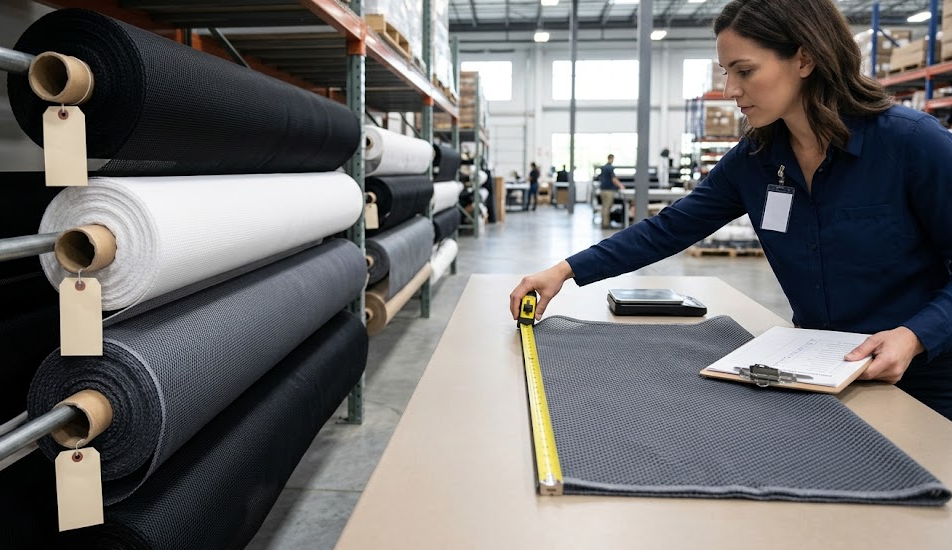
Roll goods are mesh fabric wound on a tube or core for converting, cutting or continuous manufacturing. An order may contain one or several rolls.
Cut-length mesh is a specified portion removed from a roll. It can suit a prototype or short trial, but it should not be assumed to be a retail service or an exception to the product MOQ.
Buyers can review Qicaiknitting’s wholesale mesh fabric range before asking which supply format is available for a selected construction.
Quick Decision Table
|
Buying situation |
Better starting format |
Main reason |
Confirm before ordering |
|
Laboratory or hand-feel review |
Swatch or sample |
Lowest material commitment |
Sample size and whether it represents production fabric |
|
Product prototype |
Cut length, if available |
Enough material for cutting and sewing trials |
Width, continuous length, lot and edge condition |
|
Pilot production |
Trial roll or agreed cut length |
Tests real converting behavior |
Roll length, splice policy and quantity tolerance |
|
Repeat production |
Full production rolls |
Better continuity and lot control |
Roll breakdown, lot labels and repeat specification |
|
Large continuous panels |
Full roll |
Reduces seams caused by short pieces |
Minimum continuous length and usable width |
The cutting plan, not quantity alone, determines the format. A large shade panel may require uninterrupted length even when the total order is modest.
Seven Details Buyers Should Confirm
1. Finished and usable width
Ask whether the quoted width is the total knitted width or the usable width after excluding curled, coated, damaged or otherwise unsuitable edges. Use the usable width in your cutting calculation.
2. Continuous length
State whether every piece must be continuous. “100 meters total” could mean one 100-meter length, two 50-meter rolls or another roll breakdown. These are not interchangeable when the finished product contains long panels.
3. Roll length and quantity tolerance
Confirm the target roll length, permitted variation and invoicing basis. Do not assume a tolerance; record it in the purchase order.
4. Splices and short pieces
A splice joins sections and can interrupt a cutting marker. Ask whether splices are allowed, how they are marked and whether short pieces can enter the shipped quantity.
5. Lot and shade separation
Ask the supplier to identify production or dye lots. Do not mix lots in one finished set until consistency has been checked.
6. Edge condition and fabric direction
Mesh can have different behavior along its machine and cross directions. Confirm roll orientation, edge treatment and whether the application has a required cutting direction. This matters for stretch, drape, mesh appearance and panel alignment.
7. Packing, labels and core requirements
Specify whether the material should be rolled, folded or protected against crushing. Agree on label fields and any protection needed for surfaces and edges.
Calculate Usable Quantity, Not Just Ordered Quantity
A buyer can use a simple planning equation:
Required purchase quantity = production requirement + sampling allowance + cutting loss + agreed contingency
There is no universal waste percentage for mesh. Loss depends on usable width, panel shape, direction, defects and seam allowance. Prepare a trial marker using the proposed width.
|
Quantity term |
Meaning |
Buyer action |
|
Ordered meters |
Commercial quantity on the order |
Confirm tolerance and invoicing basis |
|
Shipped meters |
Quantity recorded at dispatch |
Reconcile against roll labels and packing list |
|
Usable meters |
Material available after exclusions |
Define how defects, edges and splices are handled |
|
Converted yield |
Number of acceptable parts produced |
Validate through sample or pilot cutting |
What Should Be Written on the Purchase Order?
Use a written specification. Include:
- product name, code or approved sample reference;
- end application;
- material, knit structure, GSM, color and finish;
- usable width and width tolerance;
- total quantity and quantity tolerance;
- required roll or cut-length breakdown;
- minimum continuous length;
- splice and short-piece rules;
- lot-separation requirements;
- packing, core and label requirements;
- inspection method and acceptance criteria;
- delivery destination and requested timing.
If a specification has not been agreed, mark it [TO CONFIRM]. Do not copy MOQ, width or lead-time data from a different mesh product. For example, Qicaiknitting’s aluminium coated mesh fabric, fishing-net hexagonal mesh and mosquito mesh fabric have their own product specifications and order considerations.
If the mesh will carry load, the purchase order should not stop at GSM. Add the required yarn, mesh or prototype test and review why equal-GSM fishing nets can perform differently.
Common Ordering Mistakes
- Asking for “a few meters” without naming the product or width.
- Treating an A4 swatch as proof of roll-level consistency.
- Assuming every roll is one continuous, splice-free length.
- Comparing prices per meter without comparing usable width.
- Approving color but not recording the lot or approved sample.
- Requesting folded packing for mesh that should remain on a core.
- Placing a bulk order before conducting cutting and sewing trials.
Resolve these points before the commercial invoice and production instruction are finalized. Qicaiknitting’s guide to choosing a reliable fabric mill supplier for bulk orders covers broader supplier evaluation; this checklist focuses on order format.
Order Mesh with Qicaiknitting
Qicaiknitting supplies warp-knitted polyester and nylon mesh for mosquito nets, fishing products, tents, household goods and industrial use. Terms vary by product and customization request.
For a useful quotation, send the application, product link or reference sample, GSM, usable width, color, total quantity, roll length, continuous-length requirement, splice rule, packing request and destination. For a cut-length trial, state the exact dimensions and test. Our team will confirm availability rather than treat cut-to-length supply as a standard promise.
Contact Qicaiknitting to discuss a sample, trial requirement or bulk roll order.
FAQ
Is cut-length mesh always available below the MOQ?
No. Availability depends on stock, product construction, color, finish and production status. Ask about a sample or trial option, but wait for written confirmation before planning around it.
Does ordering a full roll guarantee one continuous length?
Not automatically. Confirm the minimum continuous length and splice policy in writing.
Should buyers compare mesh prices by meter?
Price per meter is useful only when width, specification, finish, usable quantity and packing are comparable. Cost per usable part is the better production measure.