
What Is Recycled Polyester Fabric? A Complete Guide to rPET Textiles
Nov. 25, 2026
Recycled polyester fabric is a synthetic textile made from reclaimed polyester materials, most commonly used PET plastic bottles and qualified polyester production waste. Also known as rPET fabric, it uses recycled polyethylene terephthalate (PET) to produce new textile yarns. These yarns can then be knitted or woven into fabrics for apparel, outdoor products, home textiles, and functional mesh applications.
For buyers exploring recycled textile options, Qicai Knittingoffers a range of recycled polyester mesh fabric solutions developed for functional textile applications.
For textile manufacturers and sourcing professionals, understanding recycled polyester means looking beyond its recycled content. Feedstock quality, yarn characteristics, fabric construction, and production consistency all influence the final product's performance.
Key Takeaways
-
Recycled polyester, commonly called rPET, is made by reprocessing recovered PET materials into new polyester fibers or yarns.
-
Common feedstocks include post-consumer plastic bottles and qualified pre-consumer or post-consumer polyester waste.
-
Recycled polyester can be developed into knitted, woven, and mesh fabrics with application-specific properties.
-
Fabric performance depends on yarn quality, fabric construction, finishing, and quality control rather than recycled content alone.
-
B2B buyers should verify recycled material claims and evaluate samples against their actual product requirements.
1. What Is Recycled Polyester Fabric?
Recycled polyester fabric is a textile produced using polyester yarn made from reclaimed PET materials instead of relying entirely on virgin petrochemical feedstock.
PET stands for polyethylene terephthalate, a thermoplastic polymer widely used in beverage bottles, packaging, and polyester textile fibers. When recovered PET is processed and converted into new textile material, the resulting polyester is commonly referred to as recycled polyester or rPET.
Importantly, recycled polyester is not a completely different fiber from conventional polyester. It retains the basic chemical identity of PET, although the quality of recycled feedstock and its processing history can influence the characteristics of the resulting yarn.
Recycled polyester can be manufactured into different textile constructions, including:
-
Warp-knitted mesh fabrics
-
Weft-knitted fabrics
-
Woven polyester fabrics
-
Nonwoven polyester materials
-
Blended textile materials
For functional textile manufacturers, rPET offers an alternative raw material for developing polyester-based products without necessarily changing the intended fabric construction.
2. What Is Recycled Polyester Made From?
Recycled polyester can come from different sources of recovered PET materials. The two main categories are pre-consumer and post-consumer recycled materials.
Post-Consumer PET Materials
Post-consumer recycled polyester commonly comes from used PET bottles and other discarded polyester products collected after their original use.
For bottle-based rPET, the general material preparation process includes:
-
Collecting and sorting used PET bottles.
-
Removing labels, caps, and unwanted materials.
-
Washing and processing the bottles into PET flakes.
-
Converting the recovered material into polyester feedstock.
-
Spinning the material into new polyester fibers or filament yarns.
The resulting recycled yarn can be supplied to textile manufacturers for knitting or weaving.
Pre-Consumer Polyester Waste
Pre-consumer recycled polyester can come from manufacturing waste generated before products reach consumers.
Examples include:
-
Polyester yarn production waste
-
Fabric production offcuts
-
Unused polyester textile materials
-
Other qualified polyester manufacturing residues
These materials can be collected, sorted, and reprocessed into new polyester feedstock, depending on their composition and condition.
The exact source of recycled material matters to B2B buyers because bottle-derived rPET and textile-derived recycled polyester represent different material sourcing pathways.
3. What Are the Characteristics of Recycled Polyester Fabric?
Recycled polyester can provide many of the same functional characteristics associated with conventional polyester. However, actual performance depends on the quality of the recycled yarn and the way the fabric is manufactured.
| Characteristic | Practical Consideration |
|---|---|
| Tensile strength | Depends on yarn quality, denier, and fabric construction |
| Abrasion resistance | Influenced by filament structure and fabric density |
| Dimensional stability | Depends on knitting structure and heat-setting conditions |
| Moisture absorption | Polyester generally has low moisture absorption |
| Color performance | Affected by feedstock consistency, dyeing, and finishing |
| Weather resistance | Depends on polymer quality and application-specific finishes |
| Fabric weight | Can be developed according to the required GSM |
Does Recycled Polyester Perform Like Virgin Polyester?
Recycled polyester can achieve performance comparable to virgin polyester when the recycled feedstock is properly processed and the yarn meets the required specifications.
However, recycled content alone does not guarantee identical performance.
Variations in feedstock purity, polymer degradation, spinning conditions, and yarn uniformity can affect tensile properties and processing consistency. Therefore, manufacturers should evaluate the actual yarn and finished fabric rather than assuming that all recycled polyester materials have the same characteristics.
For technical textile applications, sample testing is particularly important before confirming bulk production.
4. Recycled Polyester vs. Virgin Polyester
Both materials belong to the polyester family, but their primary difference is the source of their raw materials.
| Comparison | Recycled Polyester | Virgin Polyester |
|---|---|---|
| Raw material | Recovered PET materials | Newly produced petrochemical feedstock |
| Polymer | Reprocessed PET | Newly manufactured PET |
| Production input | Recycled flakes or other recovered feedstock | Virgin polymer raw materials |
| Textile applications | Apparel, mesh, outdoor and home textiles | Apparel, mesh, industrial and home textiles |
| Quality consistency | Depends on recycled feedstock and processing | Depends on virgin polymer and manufacturing quality |
| Environmental considerations | Can reduce demand for virgin raw materials | Requires new petrochemical feedstock |
Recycled polyester is not automatically superior in every technical application. Buyers should compare the two materials using the same fabric construction, weight, finishing requirements, and testing methods.
For a more detailed material comparison, recycled and virgin polyester can be evaluated separately based on the requirements of the intended end product.
5. Common Applications of Recycled Polyester Fabric
Because rPET can be processed into different yarn forms and textile structures, it is suitable for a wide range of applications.
Apparel and Sportswear
Recycled polyester is commonly used in sportswear, activewear, linings, and other garments where lightweight construction and polyester-related performance characteristics are required.
Outdoor and Camping Products
For outdoor equipment manufacturers, recycled polyester can be developed into mesh panels and other textile components.
Potential applications include camping tents, rooftop tents, inflatable tents, and outdoor accessories. Fabric weight, mesh opening, tensile strength, and weather-related performance should be selected according to the intended use.
Qicai Knitting provides customized warp-knitted tent mesh fabric for different outdoor textile requirements.
Window Screen Mesh
Recycled polyester yarn can also be used to develop functional window screen mesh.
Important considerations include mesh count, opening size, ventilation, visibility, dimensional stability, and resistance to environmental exposure.
These factors determine whether a particular mesh construction is suitable for residential or commercial screening applications. Explore Qicai Knitting's window screen mesh solutions for different screening requirements.
Other Functional Mesh Fabrics
Depending on yarn specifications and knitting structures, recycled polyester can also be considered for square net mesh, household textiles, and selected industrial textile applications.
6. How Is Recycled Polyester Used in Warp-Knitted Mesh Production?
For warp-knitted mesh manufacturing, recycled polyester yarn serves as the raw material, while the knitting structure determines the final mesh appearance and functional characteristics.
During production, multiple yarn ends are supplied to the knitting machine and formed into interconnected loops. Different machine settings and knitting structures can produce mesh fabrics with different opening sizes, weights, and surface characteristics.
When developing recycled polyester mesh, manufacturers should consider several factors:
-
Yarn specifications: Filament type, denier, and yarn uniformity.
-
Mesh construction: Opening size, pattern, and structural stability.
-
Fabric weight: GSM requirements based on the intended application.
-
Heat setting: Dimensional stability and shape retention.
-
Functional finishing: Additional treatments where required by the application.
At Qicai Knitting, recycled polyester is an important material direction for functional mesh development. The company's recycled fabric solutions include recycled yarn square mesh, tent mesh, and window screen mesh.
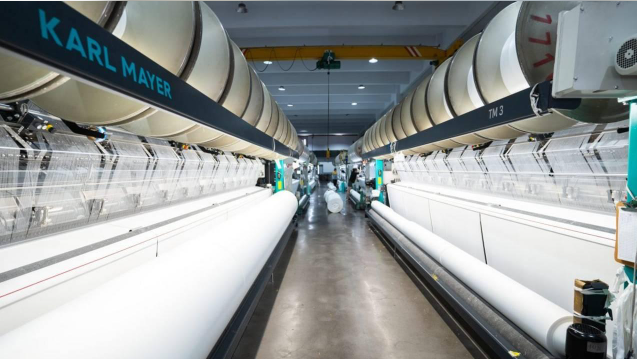
With Karl Mayer warp-knitting equipment, Qicai Knitting supports customized mesh development, sampling, and bulk production. Its manufacturing workflow includes yarn inspection, warp knitting, heat setting, functional finishing, and finished-fabric inspection.
Learn more about Qicai Knitting's warp-knitting manufacturing process and equipment.
7. What Should B2B Buyers Check When Sourcing Recycled Polyester Fabric?
Selecting a recycled polyester supplier requires more than confirming that the material is described as recycled.
Before placing a bulk order, buyers should evaluate the following points:
1. Recycled Material Content
Confirm the recycled polyester percentage in the yarn or finished fabric. Clarify whether the material is 100% recycled polyester or contains a blend of recycled and virgin fibers.
2. Feedstock Information
Ask whether the recycled material comes from post-consumer PET bottles, pre-consumer production waste, or other qualified sources.
3. Traceability and Documentation
Request appropriate supporting documents for recycled-content claims. Depending on the project, buyers may also require third-party certification and transaction-level documentation.
The Global Recycled Standard (GRS) and Recycled Claim Standard (RCS) are two relevant Textile Exchange standards for recycled material verification and supply-chain traceability.
4. Fabric Specifications
Confirm the required GSM, width, mesh count, opening size, color, and finishing requirements.
5. Sample Testing
Evaluate samples for tensile strength, tear resistance, dimensional stability, colorfastness, and other application-specific properties.
6. Manufacturing Consistency
Check whether the supplier can maintain consistent yarn sourcing, knitting structures, and finished-fabric quality across repeated production batches.
Qicai Knitting's quality control system provides further information about its fabric inspection and quality management practices.
Frequently Asked Questions
Is recycled polyester fabric made from plastic bottles?
Most commonly, recycled polyester is produced from recovered PET materials, including used plastic bottles. However, it can also come from qualified polyester manufacturing waste and other recovered polyester sources.
Is recycled polyester as durable as regular polyester?
It can be. The durability of recycled polyester depends on feedstock quality, yarn processing, fabric construction, and finishing. Buyers should evaluate finished-fabric samples against their required performance standards.
Is rPET the same as recycled polyester?
Yes. rPET stands for recycled polyethylene terephthalate. In textile applications, it is commonly used to describe polyester materials made from recovered PET feedstock.
Can recycled polyester be used for tent mesh and window screen mesh?
Yes. Recycled polyester yarn can be processed into warp-knitted mesh fabrics for these applications. However, mesh structure, yarn strength, fabric weight, and finishing must be selected according to the intended use.
Does recycled polyester fabric require certification?
Not every recycled polyester product automatically carries third-party certification. Buyers seeking verified recycled-content claims should confirm the applicable certification scope, material documentation, and supply-chain records. GRS and RCS are relevant standards to discuss with suppliers.
Conclusion: Choosing the Right Recycled Polyester Fabric Supplier
Recycled polyester fabric provides textile manufacturers with an alternative source of polyester raw material for a wide range of knitted, woven, and functional textile applications.
For B2B buyers, the most important considerations are verified recycled content, consistent yarn quality, suitable fabric construction, and reliable manufacturing processes.
As a warp-knitted mesh fabric manufacturer, Qicai Knitting supports recycled polyester mesh development for applications including tent mesh, window screen mesh, and square net mesh.
If you are sourcing recycled polyester mesh for an upcoming project, contact Qicai Knitting to discuss your required GSM, width, mesh structure, color, recycled material specifications, and finishing requirements. Customized samples and production solutions can be evaluated according to your project needs.