
What Is the Best Mesh Size for Mosquito Net?
May. 14, 2026
Quick Answer
The best mesh size for mosquito net fabric is typically between 156 and 300 holes per square inch, depending on the application and environment. A finer mesh offers better insect protection, while a slightly larger mesh improves airflow and comfort. For most household and commercial mosquito nets, polyester mesh with balanced ventilation and protection is the preferred choice.
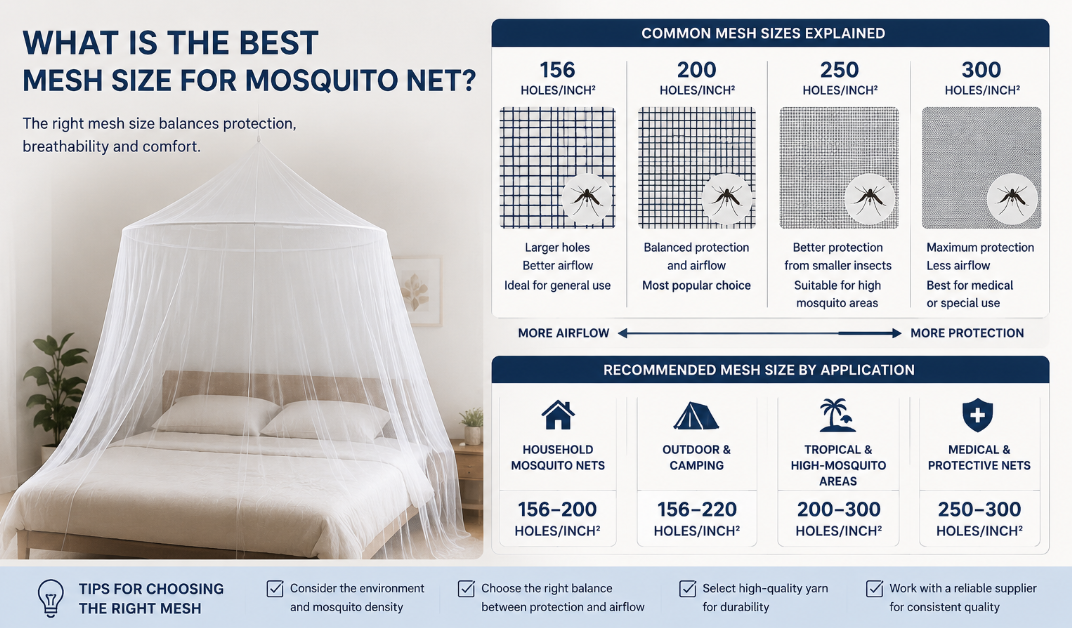
Mesh size directly affects how well a mosquito net performs. If the holes are too large, small insects may pass through. If the holes are too small, airflow can decrease, making the net less comfortable in warm climates.
The ideal mosquito net fabric should balance:
- Insect protection
- Breathability
- Visibility
- Durability
This is why choosing the right mesh specification is important for both manufacturers and buyers.
Understanding Mosquito Net Mesh Size
Mesh size refers to the number of openings or holes within a specific area of fabric. In mosquito net production, this usually means the number of holes per square inch.
In general:
- Smaller holes = better insect protection
- Larger holes = better airflow
However, smaller mesh openings may also increase fabric density and production costs.
For most applications, manufacturers aim to achieve a balance between protection and comfort rather than simply using the smallest possible holes.
Recommended Mesh Sizes for Different Applications
Different mosquito net products require different mesh specifications.
Household Mosquito Nets
Recommended mesh size:
- 156–200 holes per square inch
Benefits:
- Good airflow
- Effective mosquito protection
- Comfortable for daily use
This is the most common choice for residential mosquito nets.
Tropical & High-Mosquito Areas
Recommended mesh size:
- 200–300 holes per square inch
Benefits:
- Improved protection against smaller insects
- Suitable for humid and tropical regions
Finer mesh structures are often preferred in areas with high insect density.
Outdoor & Camping Mosquito Nets
Recommended mesh size:
- 156–220 holes per square inch
Benefits:
- Lightweight and portable
- Better ventilation for outdoor use
Outdoor products must balance protection with airflow and packability.
Medical & Protective Mosquito Nets
Recommended mesh size:
- 250–300 holes per square inch
Benefits:
- Enhanced protection
- Suitable for healthcare and sensitive environments
These products often require stricter quality standards.
Does Smaller Mesh Always Mean Better Protection?
Not necessarily.
While finer mesh can block smaller insects more effectively, extremely dense mesh may reduce airflow and increase heat buildup, especially in tropical climates.
A poorly balanced mosquito net can become uncomfortable for long-term use.
This is why professional manufacturers focus on:
- Mesh consistency
- Yarn quality
- Fabric structure
- Air permeability
rather than only increasing mesh density. Mesh consistency is not only about hole size. For magnetic door-screen manufacturing, dimensional stability also affects whether two panels remain aligned and close without persistent gaps.
Which Material Works Best for Mosquito Net Mesh?
The material used also affects mosquito net performance.
Polyester Mesh
Polyester is the most popular choice because it offers:
- Excellent durability
- Moisture resistance
- Cost-efficiency
- Stable mesh structure
For most commercial mosquito net applications, polyester mesh provides the best balance between performance and affordability.
Nylon Mesh
Nylon offers:
- Softer texture
- Higher flexibility
- Better tensile strength
However, it is usually more expensive than polyester.
Cotton Mesh
Cotton is less common today because:
- It absorbs moisture
- Requires more maintenance
- Has lower durability
It is mainly used in decorative or niche applications.
How Mosquito Net Fabric Is Manufactured
Mosquito net fabric is typically produced through warp knitting or weaving processes.
Warp knitting is widely used because it creates:
- Stable mesh openings
- High production efficiency
- Strong and durable structures
At Qicaiknitting, warp knitting technology is used to produce customized mosquito net mesh fabrics with consistent quality and precise mesh structures for different market needs.
How to Choose the Right Mosquito Net Fabric
When selecting mosquito net fabric, buyers should consider:
1. Target Market
Different regions may require different mesh densities and standards.
2. Climate Conditions
Hot and humid environments usually need better airflow.
3. Product Positioning
Premium products may use finer mesh and softer yarns.
4. Production Cost
Higher mesh density generally increases material usage and cost.
Working with an experienced mosquito net fabric supplier can help optimize both product performance and manufacturing efficiency.
Why Customization Matters
Not all mosquito net products use the same mesh specification.
Customization options may include:
- Mesh size
- Fabric weight (GSM)
- Yarn type
- Color
- Elasticity
At Qicaiknitting, customized mosquito net mesh solutions are available for household, medical, outdoor, and commercial applications.
Final Thoughts
The best mesh size for mosquito nets depends on the intended application, environment, and comfort requirements. In most cases, a mesh size between 156 and 300 holes per square inch provides an effective balance between protection and airflow.
For manufacturers and wholesalers, selecting the right material and mesh structure is just as important as choosing the right mesh density.
If you are sourcing mosquito net fabric for your business, working with a professional mesh fabric manufacturer can help ensure consistent quality and long-term product performance.